Cercar

dilluns, 8 de juny del 2020

Geostrategic Dimensions of Libya’s Civil War (18 de maig 2020)

https://africacenter.org/publication/geostrategic-dimensions-libya-civil-war/

Tarek Megerisi

Libya’s civil war has become an increasingly competitive geostrategic struggle. A UN-brokered settlement supported by non-aligned states is the most viable means for a stable de-escalation, enabling Libya to regain its sovereignty. 


HIGHLIGHTS


  • The Libya conflict has escalated into an increasingly dangerous geostrategic competition for influence, pitting the UAE, Egypt, and Russia against Qatar, most of Europe, and Turkey in a petroleum-rich country straddling the regions of North Africa, southern Europe, the Sahel, and the Middle East.
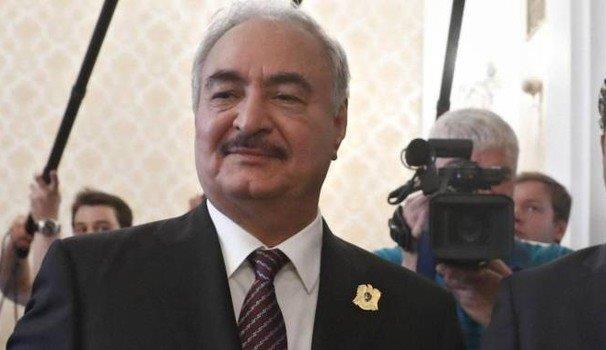
  • General Khalifa Haftar lacks a strong domestic constituency and instead serves largely as a proxy for external actor interests. He has, moreover, consistently acted as an obstacle to de-escalation and stabilization. Consequently, he lacks the standing to be treated as a political equal to the UN-backed government.
  • A UN-brokered settlement supported by nonaligned states is the only viable means for a stable de-escalation that would generate a nonthreatening outcome for the regional competitors while enabling Libya to regain its sovereignty.
Conflict in Libya has claimed the lives of tens of thousands, generated instability throughout North Africa and the Sahel, and become an increasingly pitched focal point for geostrategic competition. Since April 2019, the civil war in Libya has intensified particularly in the west of the country, where General Khalifa Haftar’s Libyan National Army (LNA) laid siege to Tripoli in a bid to oust the United Nations-supported Government of National Accord (GNA). The United Nations Support Mission in Libya (UNSMIL) estimates some 231,000 civilians are in the immediate frontline areas, with an additional 380,000 living in areas directly affected by conflict. More than 370,000 people are estimated to remain internally displaced by the violence and hundreds of civilians have been killed since Haftar’s April 2019 assault.1
According to UNSMIL, the LNA and affiliated forces conducted at least 850 precision air strikes by drones and another 170 by fighter-bombers between April 2019 and January 2020.2 Of these, some 60 precision air strikes were conducted reportedly by Egyptian and Emirati fighter aircraft. Meanwhile, the GNA and affiliated forces conducted roughly 250 air strikes.
The economic impact of the conflict coupled with the COVID-19 pandemic may cause the country’s GDP to contract by more than 12 percent in 2020. The LNA’s blockade of oil terminals since January 2020 has further deepened the economic crisis. Oil production has plunged to around 120,000 barrels per day from 1.14 million in December 2019. This has resulted in financial losses of approximately $2 billion per month for the state-owned enterprise.3
While the United Arab Emirates (UAE), Qatar, and Egypt have been supporting competing sides of the Libyan conflict from its early stages, the geostrategic stakes escalated in September 2019 with the deployment of Russian mercenaries in support of Haftar’s forces. This precipitated an intervention of Turkish ground forces in support of the GNA. In addition, external actors have deployed Syrian, Chadian, and Sudanese mercenaries, drones, ground-to-air defense systems, and other high-tech assets in an attempt to swing the balance in favor of their proxies.
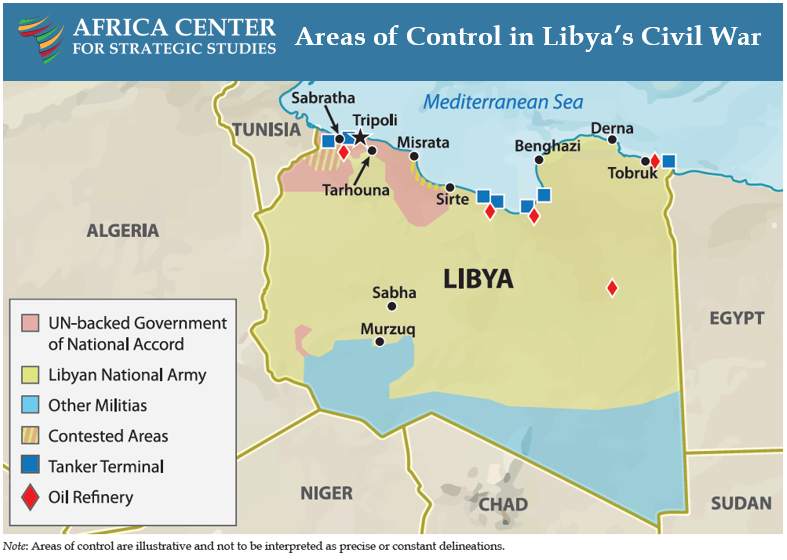
Figure 1 - Areas of Control in Libya's Civil War
Note: Areas of control are illustrative and not to be interpreted as precise or constant delineations. (Click image for shareable version.)
Libya’s post-revolutionary decline toward fragmentation and state collapse represents a growing cause for alarm. With external actors coalescing around the two main Libyan factions, the conflict has become increasingly internationalized. This has compounded its complexity, taking on drivers far different from those with which it began. The internationalization of the conflict poses a geostrategic nightmare for the UN’s efforts toward stabilization and has upped the stakes for Libya’s civil war, posing an even greater threat to international security.4

Drawing Battle Lines

The internationalization of Libya’s transition began with what itself was a very internationalized revolution. The North Atlantic Treaty Organization’s (NATO’s) 2011 intervention, which largely took place from the skies, received most of the attention during Libya’s moment in the Arab Spring. Less recognized, however, were the rival interventions by Qatar and the UAE to equip, train, and otherwise assist Libyan revolutionary militias on the ground, which set the scene for a competition that would come to define Libya’s revolutionary aftermath.
The two Gulf States mobilized their assistance through proxies with whom they had pre-existing relationships and who came to represent their divergent interests. Those who fell into Qatar’s camp included Libyan actors who were ideologically opposed to Muammar el Qaddafi as a tyrant, those who had often been imprisoned or persecuted by him, and those who defined their opposition in Islamist ideology. The UAE maintained links with a technocratic class who had often worked with Qaddafi’s son in a failed reform attempt and with older generations of opposition.
During the revolutionary war, these two distinct camps were often demarcated by personal contacts with a particular militia leader, a go-between from the older generation, or ties to a geographical area. As the war progressed, their military operations, diplomatic dealings, and the machinations of their political proxies who pursued exclusive control over Libya’s levers of power pitted the two camps against each another. The rift grew in acrimony even as the war ended and as the country’s first elections in over half a century took place in July 2012 to elect a parliament, the General National Congress (GNC). This would become the first theatre of this new, now more political, conflict.
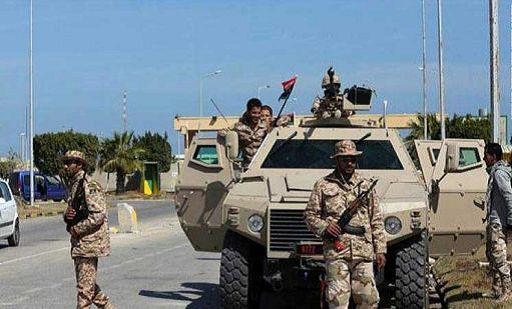
Libyan GNA soldiers return from frontlines
Soldiers allied to the internationally-backed Government of National Accord returning from the front lines in Tripoli, April 2019. (Photo: VOA/H. Murdock)
The two coalitions continued to confront each other rather than compromise in a zero-sum pursuit of wealth and authority encouraged by their backers. The National Forces Alliance (NFA), a political coalition with close ties to the UAE, won a majority and was able to command 64 seats of the GNC (including nominally aligned members of parliament). The Justice and Construction Party (JCP), Libya’s Muslim Brotherhood-aligned political party, counted 34 seats. The myopic use of militias by domestic political actors to achieve their internal political outcomes institutionalized violence as a political tool. Meanwhile, competition over often corrupt business dealings with international partners destroyed the integrity and legitimacy of the GNC as an institution. Once the NFA, plagued by internal fissures and consistently outmaneuvered, failed to make its initial majority count, the coalition boycotted the GNC, severely undermining its effectiveness.
Although the UN hoped that a fresh round of elections could restart a political transition that had been lost to the greed and immaturity of Libya’s political class, the damage was done. Libya’s foreign and domestic factions had fossilized, the use of violence had normalized, and a zero-sum mindset had become locked-in.

Libya’s Geostrategic Significance

If the Arab Spring was a time of regional flux for the Middle East and North Africa, to those in the Gulf with a more stable perch and considerable resources, it was a time of opportunity. As the old pillars of the region collapsed— first Iraq, then Syria, and then Egypt—there was a sense that the moment was ripe for a new regional order. Qatar took the view, perhaps born of its own history of palac e coups, that revolutions birthed new orders and new elites, and thus fully supported revolutionary actors in the hopes that this would create a regional network of friendly, if not gracious, states. Their own role in hosting many of the region’s exiled Islamist dissidents, and the fact that most organized long-standing opposition movements in the region were themselves Islamist, meant that their regional enterprises had a distinctly Islamist flavor.
If Qatar’s approach was built on opportunism and the prospects of soft power, then the UAE’s was forged from fear and realpolitik. The harsh domestic crackdowns on activists and those offering even modest proposals for reform showed an undercurrent of fear in Abu Dhabi that the Arab Spring contagion might cross Emirati borders. Its regional strategy since then shows an Emirati preference for evolution over revolution with a focus on securing key interests. This preference for recreating the old order with new leaders is evident in the UAE’s support for General Abdul Fattah el Sisi in Egypt, the jewel of this policy. Emirati activities in Yemen showcase the economic angle of its policy, an oil diversification strategy to become the regional leader in shipping and logistics, all while maintaining a dominant presence in the network of ports connecting the Far East to the Atlantic.
Libya’s strategic location at the heart of the Mediterranean, the Maghreb, and as a door to sub-Saharan Africa, as well as its significant oil and gas reserves and its revolutionary upheaval, meant that it fell neatly at the intersection of Emirati ideological and economic policies.5 As the remnants of the state crumbled and Libya destabilized, it attracted others like Egypt and France who saw an opportunity to build a friendly state that could be useful for their own economic, security, and regional policymaking interests.6 This dynamic continued as Libya’s decline persisted and worsened.

The Haftar Project

“Moving away from politicians employing militias toward a paradigm whereby militias employed politicians.”
The collapse of the GNC was a turning point in Libya’s transition, symbolized best by the re-emergence of Qaddafi-era General Khalifa Haftar who had failed to establish himself after Qaddafi’s ouster. In 2011, he was quickly sidelined and ostracized. Many Libyans were unwilling to work with him, deeming him responsible for atrocities committed during the Chadian war of the 1980s. Others saw him as a divisive force given that they already had a commander, Abdul Fatah Younis. Haftar’s next emergence, a coup-by-television on Valentine’s Day 2014, was laughed off by many at the time. However, it represented the beginning of politics by other means in Libya—the moving away from politicians employing militias toward a paradigm whereby militias employed politicians to provide a shroud of legitimacy.
Although Haftar has often leveraged local Libyan grievances, such as the rise of jihadism in eastern Libya or a long-standing oil blockade by rogue militias, his attempt to grow his position and attract supporters has never been an entirely Libyan or autonomous enterprise. Haftar’s reintroduction to Libya passed through Cairo, where his vision of emulating Qaddafi’s quasi-military dictatorship found resonance with a resurgent Egyptian military institution emboldened by the successful installation of Sisi following Egypt’s aborted democratic transition.
While Haftar’s coup attempt failed to gain traction in Tripoli, he quickly discovered a new raison d’être over the course of 2014—by launching a war on terror in eastern Libya.7 This allowed him to remain close to Egypt, which supplied him militarily to construct a hybrid security institution that patched together former regime intelligence and military officers with tribal militias and other auxiliary forces such as Salafists. This movement came to represent one side of the growing national divide as some sympathetic and recently elected politicians from the new parliament, the House of Representatives, ordained Haftar and his forces as Libya’s national armed forces. These same politicians had unilaterally moved this new legislative body to Tobruk in eastern Libya in an attempt to side-step their opponents and dominate the parliament, effectively bifurcating governance of the country.
Although the UN attempted to build a new power-sharing institution, the Government of National Accord (GNA), Haftar’s backers lost interest in political compromise in 2015. Under the cover of the war on terror narrative, the UAE built an airbase near Haftar’s headquarters in eastern Libya while the French deployed special forces and provided other expert assistance. Coming at a time when France was increasing its counterterrorism activity to Libya’s south in the Sahel, Haftar’s counterterrorism narrative and Emirati support (with whom France already enjoyed a close security partnership) made him a natural ally. Moreover, Haftar and his wider movement was considered a useful vehicle to expand French influence in Libya, which had long been dominated by Italy, and a key component of the wider security architecture the French were building in the Sahel.
With his external support in place, Haftar refused to support the Libyan Political Agreement, which was intended to reunify the country, and ultimately declared the agreement void in 2017.8 Haftar himself spent much of this time refusing to meet with any UN or diplomatic missions that were not coming to offer support, as he built up his base in eastern Libya.9 As the war on terror gradually ended, his foreign backers provided him the technology, finances, airpower, and manpower needed to extend his network further to acquire Libya’s oil export terminals and to conquer the remainder of eastern Libya. All the while, they ensured that no international criticism could come his way for a growing litany of war crimes committed by LNA forces including besieging the city of Derna, the execution-style killings of captured fighters from the Shura Council of Benghazi Revolutionaries, and at least 7 other incidents involving orders from a LNA commander to kill at least 33 prisoners in the area around Benghazi.10
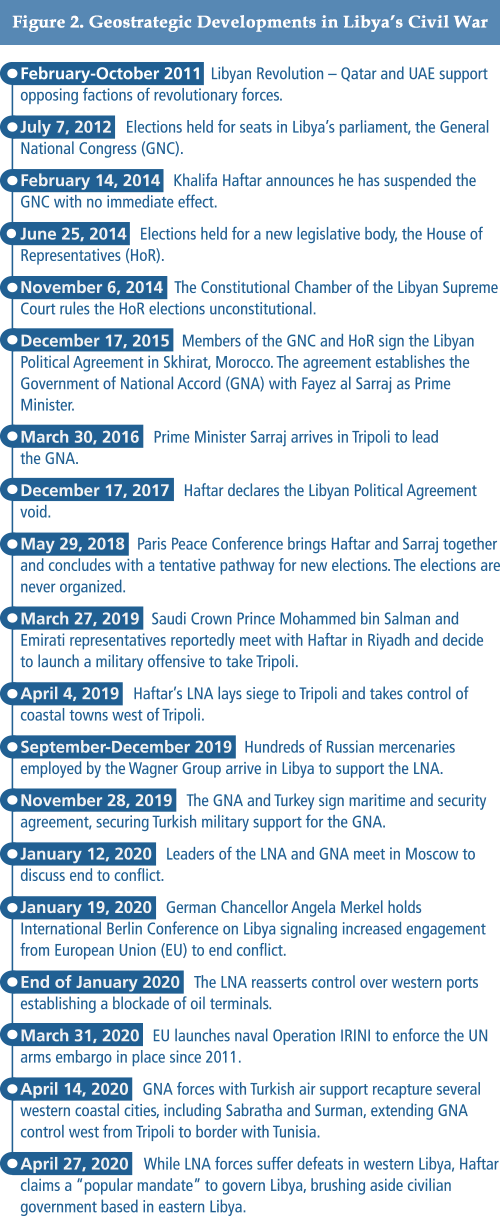
Figure 2 - Geostrategic Developments in Libya's Civil War


The Sacrificial Sarraj
The UN talks which birthed the GNA in December 2015 began as a process firmly backed by a host of countries, including the United States, the United Kingdom, and Italy, in the hopes that it could end Libya’s civil war and create a credible partner for combatting terrorism and migration. However, as the talks dragged on, the crisis worsened, and with hundreds of thousands crossing the Mediterranean and the Islamic State having taken the city of Sirte a year earlier, these needs became more acute. The Libyan Political Agreement which resulted from the UN talks held little local legitimacy and exhibited minimal structural capability to enforce many of its provisions, such as those to secure the capital. Moreover, the new Prime Minister, Fayez al Sarraj, a relatively unknown politician with no clear constituency, was chosen by virtue of being the least controversial and thereby most agreeable person to be found.
Sarraj and his weak government were delivered to Tripoli in March 2016 on an Italian naval vessel. The GNA struggled to operate in a city controlled by militias that were more than happy to hold the GNA hostage as a means of tapping the country’s central bank. Unable to immediately contribute to the counterterror or counter-migration efforts, many international actors who had supported the UN and the GNA quickly abandoned it for more expedient policies. These policies often revolved around nonstate actors and further undermined the GNA, reducing it to the status of a payer rather than a player.
The GNA’s lack of political power was on full display when French President Emmanuel Macron hosted a conference between Haftar and Sarraj in 2018.11 Dubbed a peace conference, despite the two parties never actually having been at war with each another, it created a false equivalence between the civilian leader of the country and the commander of one of the country’s multitude of armed groups. It also set in play a dynamic that molded Libya’s political process over the coming years, with Sarraj being forced to negotiate deals with Haftar who continued expanding his presence and military power. Meanwhile, even the GNA’s staunchest allies, such as Italy, who had considered Sarraj key to preserving their influence in the country, began to lose confidence.
UN Special Representative Ghassan Salamé tried to break this mold during 2018-2019 to create a new, inclusive political process that would lead to a new civilian government and national security institutions more reflective of Libya’s patchwork of political and military actors. Following a power-sharing agreement struck between Haftar and Sarraj in Abu Dhabi at the end of February 2019, the new UN plan seemed to offer some hope. However, the plan remained highly contested with many in Libya refusing to support it, which eroded UN and international credibility in the country. On March 27, 2019, in a reported meeting between Saudi Crown Prince Mohammed bin Salman, Haftar, and Emirati representatives, the decision was made that Haftar would try to seize power by launching a surprise attack on Tripoli—even as UN Secretary General António Guterres was in town trying to salvage the UN-backed political process.

Tripoli or Bust

Haftar’s plan to blitzkrieg Tripoli and assume power in April 2019 failed. He quickly found himself in a war of attrition confronted by the greatest mobilization of fighters Libya had witnessed since the 2011 revolution against Qaddafi.12 He simultaneously struggled to maintain long supply lines through territory that he controlled only nominally. However, the decision to take Tripoli left Haftar and his backers with few alternatives but to persist or risk losing everything. The finality of the situation, whereby either Haftar wins and sets up a new dictatorship or he loses and a new chapter of Libya’s transition begins, mobilized Libyans as well as other international actors, namely Russia and Turkey.
“[I]t created a false equivalence between the civilian leader of the country and the commander of one of the country’s multitude of armed groups.”
Russia has long used Libya’s slow-burning conflict to advance its relationships with Egypt and the UAE, while simultaneously expanding its influence on Europe’s southern border and its access to Libya’s natural resources. Sensing an international vacuum and an opportunity to leverage its influence in a petroleum-rich country in the southern Mediterranean, Russia pulled a page from its Syria playbook to prop up a weak and isolated authoritarian leader in a conflict most global actors wanted to avoid.13 In September of 2019, Russia began to deploy an estimated 800-1,200 Russian mercenaries through the Wagner Group led by Yevgeny Prighozin, the same outfit that Russia has deployed to conflicts in Ukraine, the Central Africa Republic, Mozambique, and Mali. The Russian deployment tilted the balance of the conflict in Haftar’s favor.14 Destabilization and conflict in Libya created opportunities for mischief, growing Russian influence in the region, and ensuring Russia played a role in any settlement.
Turkey has long maintained an interest in Libya as an economic partner where it holds over $20 billion in frozen contracts that, if resumed, might boost its otherwise worsening economy. Moreover, the success of the Haftar project would cement Emirati and Egyptian influence in North Africa and present a serious obstacle to Turkish prospects in the region.
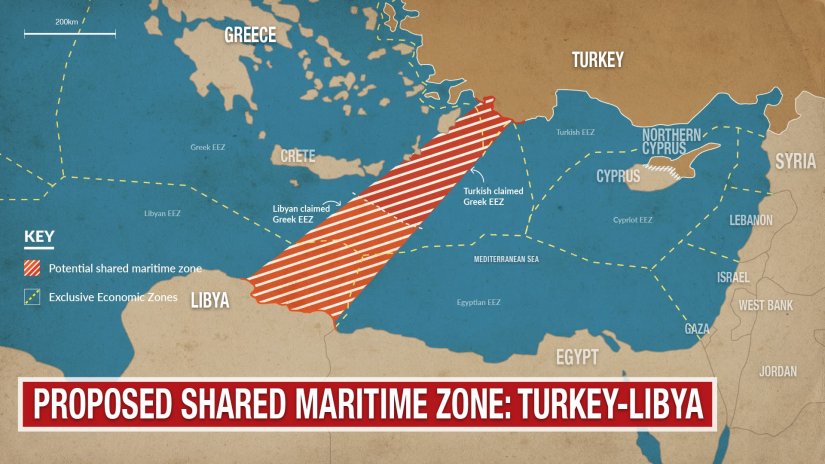
Haftar’s assault on Tripoli forced Turkey to either move against or acquiesce to the UAE/Egyptian/Russian gambit to claim Libya. It also provided Turkey an opening to advance its eastern Mediterranean interests. Following the February 2018 discovery of significant gas reserves in the eastern Mediterranean, a coalition between Greece, Cyprus, Israel, and Egypt began to develop security and economic infrastructure, which Turkey viewed as a direct threat to its economic interests and dominant security role in the region.15 The desperation of Libya’s GNA and the apathy of the West toward stopping Haftar gave Turkey the leverage it needed. By the end of November 2019, the besieged GNA readily signed an agreement that delineated maritime borders between Libya and Turkey and created an exclusive economic zone covering key gas fields in exchange for Turkish military support. With Turkish troops deployed and air support in place, the GNA was able to reclaim several strategic towns in western Libya in April 2020. Haftar’s forces have subsequently been forced to retreat to rear bases around Tripoli such as the town of Tarhouna.
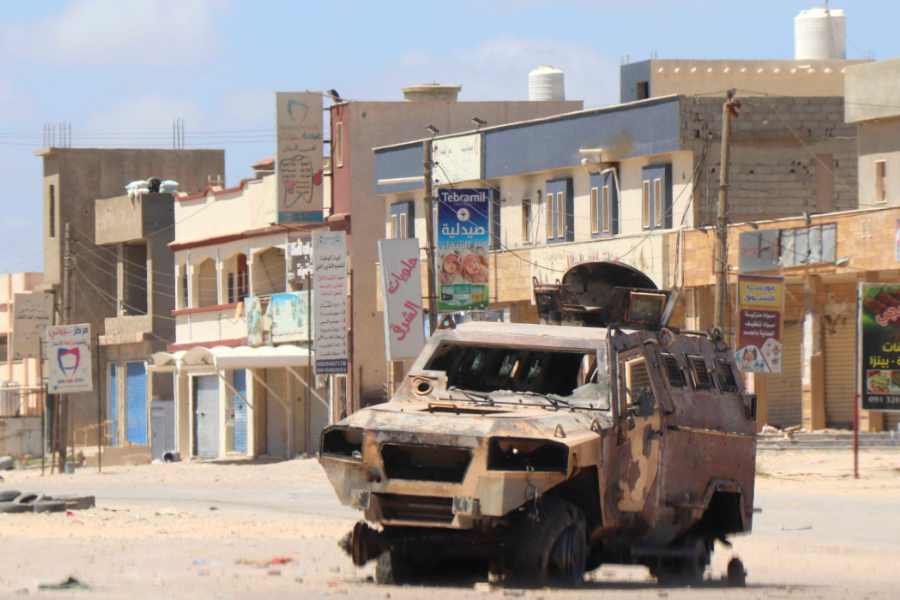
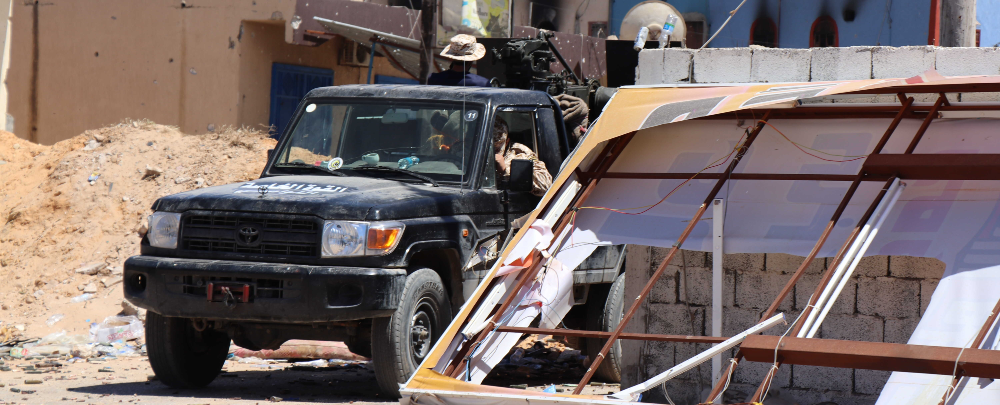
A burnt-out vehicle is left behind after a battle in Tripoli, April 2019
A burnt-out vehicle left behind after a battle in Tripoli, April 2019. (Photo: VOA)
The sudden and sharp growth of Turkish and Russian involvement since late 2019 has been happily absorbed by Libyan actors who are desperate not to lose. The military prowess of both countries has quickly led to them being key actors on the ground while impinging on European interests and potentially shutting the West out of any peace settlement.
The temporary truce declared on January 12, 2020, during a meeting in Moscow, highlighted these fears. The rapid announcement of the Berlin conference set for January 19, following months of high-level meetings, was Europe’s attempt to maintain relevance. At the end of March 2020, Europe launched a revamped naval operation, IRINI (Greek for “Peace”), to enforce the UN arms embargo in place since 2011. The formalization of Operation IRINI, however, has laid bare divisions within the European Union (EU) as Greece pushed for the mission to focus on disrupting Turkey’s naval resupply routes with the presumably larger aim of killing the Turkish-Libyan maritime and security agreement. In addition, enforcing a maritime arms embargo without a simultaneous blockade of arms coming overland from the UAE would, in effect, help Haftar. This calculation no doubt factored into Turkey’s decision to take matters into its own hands. It remains to be seen whether the EU, through the likes of Germany, will be able to use Operation IRINI to facilitate holding all embargo violators accountable, or if European divisions will ultimately cause the operation to be ineffective.

Escalation Ahead on the Eastern Front

“[U]nless nonaligned states can protect and support the UN to launch a genuine political process, the external actors engaged in Libya’s civil war will continue escalating.”
The war in Libya is set for a dramatic escalation. Given Haftar’s disadvantages in western Libya and the considerable Turkish support therein, Haftar is unlikely to make further gains and is already growing increasingly reliant on artillery just to maintain his positions. As the situation in western Libya worsens for him, he is likely to refocus his remaining offensive capacity on the de facto eastern front between the cities of Misrata and Sirte. However, further east, where Turkish air defenses are not present, he will likely remain unbreachable and comfortably absorb attacks by a GNA that is desperate to regain the country’s oil terminals.
As the war drags on, Europe has become more anxious at the potential destabilizing consequences of an internationalized conflict in its immediate backyard, potentially precipitating a new surge of refugees.16 The active role of France, however, blunts the multilateral instruments—the EU and UN—that Europeans are most comfortable using. Meanwhile, the United States, which Europe is accustomed to depending on for any force projection, appears unwilling to engage in another intractable conflict, let alone one where allies such as the UAE and Turkey are in direct opposition.
It is almost inevitable that the UAE will seek to regain the upper hand through further deployments of mercenaries and weapons shipments. More crucially will be its attempts to regain aerial superiority from Turkey, which could involve importing Israeli air defenses following the inability of Russia’s Pantsir system to effectively neutralize Turkey’s drones.17 Further severe losses could lead to the introduction of advanced Emirati and Egyptian aircraft. This would be a dangerous escalation that Turkey already seems to be preparing for with training drills involving its own F-16s in the Mediterranean.
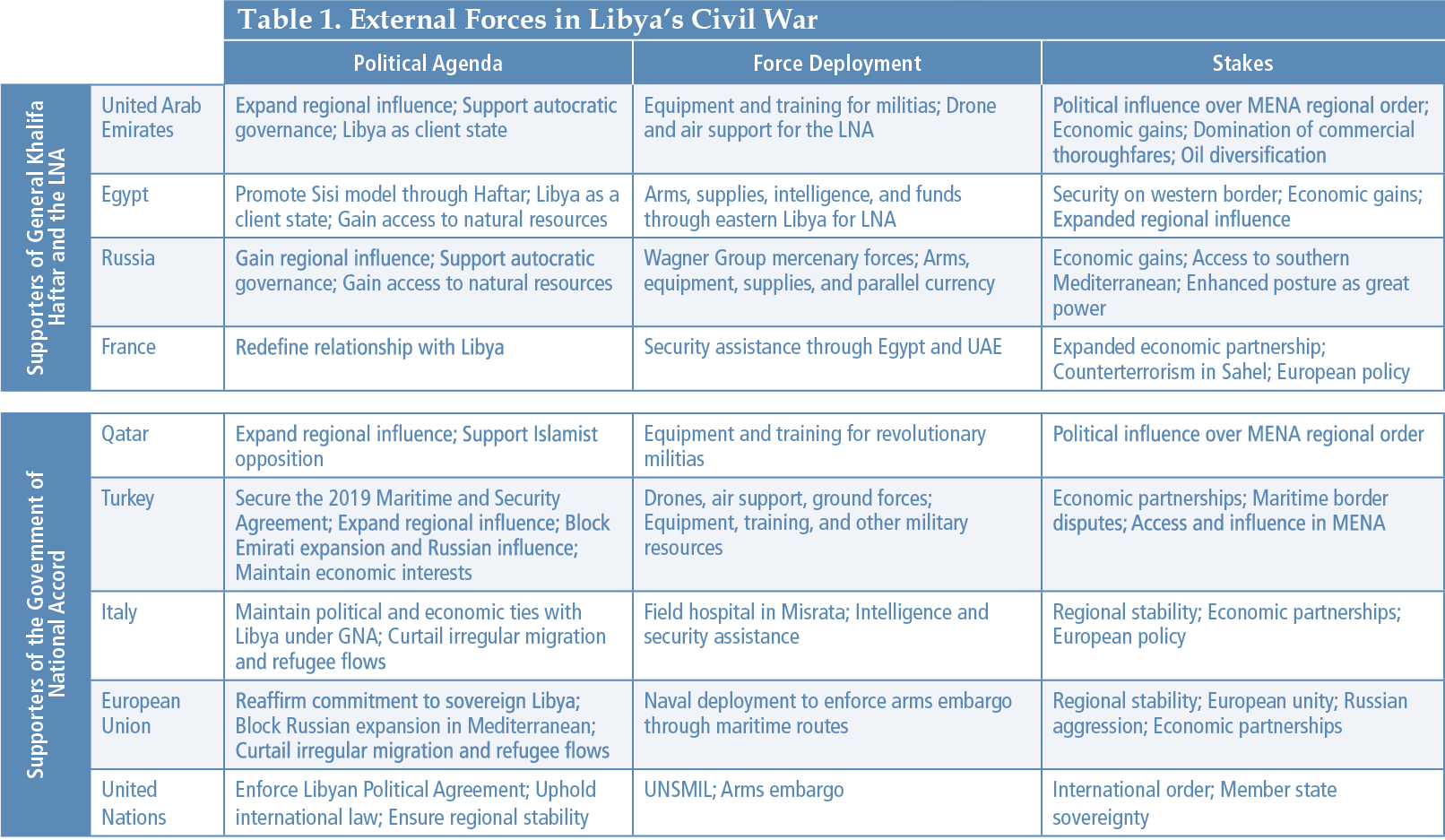
Table 1. External Forces in Libya's Civil War
All these developments point to an escalation of the increasingly destructive conflict. The removal of Haftar from western Libya may begin a new and perhaps more difficult campaign to dislodge the LNA from Libya’s oil fields in the south and oil terminals along its eastern coastline. More worrying for Libya’s future would be if Haftar moves to deepen the partition of the country in response to his military weakness. This could be done by trying to once again sell oil illicitly if he believes there will be no international pushback this time around.
Unless nonaligned states can protect and support the UN to launch a genuine political process, the external actors engaged in Libya’s civil war will continue escalating their attempts to seize control of this desert country that promises much yet delivers little more than squandered resources and frustration to its would-be overseers.

Supporting the UN and Avoiding Protracted Conflict

At its core, Libya’s war has been driven by the aspirations of regional powers, following their hijacking of the Libyan transition. These actors are now vying to reshape the region in their own image in a dangerous race to the bottom. Following are priority areas for policy action to reverse this trend and avoid an extended conflict in Libya.
Recognize the UN as the best honest broker. The escalation of the conflict by external actors means there are more interests and reputations at stake than there were previously. Given the relatively low costs each of these actors is incurring by supporting proxies, they have the means and incentives to continue escalation. By recognizing the UN as the best body to facilitate a de-escalation and negotiated settlement, all sides will have greater assurances that their interests will be considered. This reduces the “winner-take-all” undercurrent that has been driving the geostrategic aspects of this conflict. It is also the only option whereby Libyans will have the opportunity to reassert their sovereignty rather than existing as a vassal state to other regional actors.
Stop treating Haftar as a viable alternative. The impossibility of Haftar winning this war and being capable of ruling Libya has been made painfully clear with the GNA’s April 2020 offensives led by Turkey. Even before that, the scale of the mobilization triggered against him, his lack of a strong domestic constituency, absence of legitimacy, and his reliance on foreign mercenaries, equipment, and aircraft indicates that Haftar’s best case scenario would be a prolonged urban war that would destroy Tripoli and only set him up for further conflicts in cities like Misrata.
Having scuttled previous efforts by the UN and then launching an assault on the capital after agreeing to a power-sharing deal with Sarraj in February 2019, Haftar has proven himself an unreliable negotiating partner. Moreover, he has made his ambition to be Libya’s next authoritarian leader abundantly clear on multiple occasions and violated every ceasefire offered, including the terms of the January 2020 Berlin Conference.
Haftar, accordingly, seems to be the ultimate spoiler to de-escalation and stabilization in Libya. While Haftar is often treated as an essential part of a solution, in fact, a resolution to the conflict would be far easier by not treating him as the governing equivalent of the GNA. Better prospects can be realized by engaging those under him in order to enforce a ceasefire and build a joint security institution.
Display a unified European policy for the conflict in Libya. The lack of a unified European position on Libya has enabled Russia to gain leverage and expand its influence on Europe’s southern flank. This poses a far more serious threat to Europe than any intra-European differences. Russia’s deepening involvement in Libya, accordingly, should be a rallying point for EU and NATO members.
This does not necessitate partisan involvement in Libya’s war, but rather a common policy position from the West that enforces the UN arms embargo, defends international norms, upholds the integrity of Libya’s National Oil Corporation as the sole legitimate seller of Libyan oil, and ring-fences the UN process as the only game in town. This would significantly constrain Russia’s operation enacted through mercenary groups, arms transfers, and attempts to help Haftar sell oil illicitly. Not only would this make Russia’s involvement more costly for Moscow but it could also block further Russian expansion and counter the inroads Russia has already made.
Enforce international norms to stop the escalations. The violations of the UN Security Council-mandated arms embargo on Libya are a central driver of the conflict and allow Libyan belligerents, especially Haftar, to ignore calls for a ceasefire with impunity. Using assets such as the EU’s Operation IRINI as well as other satellite and aerial monitoring is a quick way to gather evidence on all violations that can be used to enforce the arms embargo in an unbiased fashion. If trying to hold violating states, such as the UAE, accountable is considered too politically sensitive, or if the Security Council is too divided to act, then other options remain available. A clear message can still be sent through unilateral sanctions on the private companies used by the UAE and others to send arms. Additionally, those who run private military contractors such as Yevgeny Prigozhin’s Wagner Group could also be sanctioned in an attempt to create an environment in Libya that is more conducive to peace.
A pressure campaign of this sort can also be applied to Libyan belligerents who seek to undermine the UN process. Similar sanctions in 2014 against the heads of rival parliaments and governments were considered key to facilitating the talks that birthed the Libyan Politic al Agreement and the GNA. Libyan actors and external governments that are attempting to undercut the UN process persist in doing so because they bear little cost to themselves. Moving to end this culture of impunity would be a relatively peaceful way of altering behaviors.
Make a national ceasefire more resilient through local ceasefires. The decentralized nature of Libyan society and the various militias that comprise both rival coalitions means that a national ceasefire can only be made resilient by engaging the communities actually fighting. Focusing on “local ceasefires” between directly warring communities such as Misrata and Tarhouna is a key step toward preventing the reemergence of conflict and starting to construct truly national security institutions in Libya. Working from the local level up is vital to alleviating the insecurities of communities that otherwise create openings for nefarious foreign involvement and building resilient institutions that can better resist foreign influence.
Tarek Megerisi is a policy fellow with the North Africa and Middle East program at the European Council on Foreign Relations, specializing in politics, governance, and development in the Arab world. He has worked extensively on Libya’s transition since 2012 with Libyan and international organizations.

Notes

  1. ⇑ “Libya Situation Report,” United Nations Office for the Coordination of Humanitarian Affairs, April 29, 2020.
  2. ⇑ United Nations Security Council, United Nations Support Mission in Libya: report of the Secretary-General, S/2020/41 (January 15, 2020).
  3. ⇑ “Oil Blockade Continues to Ravage Economy,” Economist Intelligence Unit, March 4, 2020.
  4. ⇑ Tarek Megerisi, “Libya’s Global Civil War,” Policy Brief (London: European Council of Foreign Relations, 2019).
  5. ⇑ Anouar Boukhars, “The Maghreb’s Fragile Edges,” Africa Security Brief No. 34 (Washington, DC: Africa Center for Strategic Studies, 2018).
  6. ⇑ Karim Mezran and Arturo Varvelli, eds., “Foreign Actors in Libya’s Crisis,” Atlantic Council and ISPI Report (Milan: Italian Institute for International Political Studies, 2017).
  7. ⇑ Mirco Keilberth and Fritz Schaap, “A Warlord Rebuilds Benghazi in His Own Image,” Spiegel International, September 13, 2019.
  8. ⇑ Libyan Political Agreement, as signed on December 17, 2015, in Skhirat, Morocco, available on the UNSMIL website.
  9. ⇑ David D. Kirkpatrick, “A Police State with an Islamist Twist: Inside Hifter’s Libya,” New York Times, April 14, 2020.
  10. ⇑ “Evidence points to war crimes by Libyan National Army forces,” Amnesty International, March 23, 2017. “UN says it is concerned about LNA siege of Derna,” Libya Herald, August 6, 2017. “Situation in Libya: ICC Pre-Trial Chamber I issues a warrant of arrest for Mahmoud Mustafa Busayf AL-WERFALLI for war crimes,” press release ICC-CPI-20170815-PR1328, International Criminal Court, August 15, 2017.
  11. ⇑ Claudia Gazzini, “Making the Best of France’s Libya Summit,” Briefing No. 58, International Crisis Group, May 28, 2018.
  12. ⇑ Wolfram Lacher, “Who is Fighting Whom in Tripoli? How the 2019 Civil War is Transforming Libya’s Military Landscape,” Briefing Paper (Geneva: Small Arms Survey, 2019).
  13. ⇑ Joseph Siegle, “Recommended US Response to Russian Activities in Africa,” in “Russian Strategic Intentions,” Nicole Peterson, ed., Strategic Multilayer Assessment (SMA) White Paper (Boston: NSI, 2019).
  14. ⇑ Frederic Wehrey, “With the help of Russian fighters, Libya’s Haftar could take Tripoli,” Foreign Policy, December 5, 2019.
  15. ⇑ Michael Tanchum, “A Dangerous policy of Turkish containment in the Eastern Mediterranean,” Jerusalem Post, July 10, 2019.
  16. ⇑ Tarek Megerisi, “Why the ‘ignored war’ in Libya will come to haunt a blinkered west,” Guardian, March 24, 2020.
  17. ⇑ Anna Ahronheim, “Is an Israeli air defense system shooting down Israeli drones in Libya?” Jerusalem Post, April 12, 2020.

dimarts, 26 de maig del 2020

UAE-Turkish Rivalry Wreaks Regional Havoc in Libya and Syria

by James M. Dorsey | May 22, 2020


The United Arab Emirates and Turkey are locked into a regional power struggle that has fuelled conflict in Libya and could spark renewed fighting in Syria. It is a struggle, like that between Saudi Arabia and Iran, that threatens to keep the Middle East and North Africa on edge.

The Saudi-Iranian dispute may dominate headlines but a similar rivalry between Turkey and the United Arab Emirates is equally wreaking havoc in the Middle East and North Africa.

While Saudi Arabia may in some ways have a leg up on Iran, Turkey and the UAE are at a virtual draw.

In Libya, forces of the Turkish-backed GNA are pushing UAE-backed rebels led by Khalifa Haftar out of western Libya.

In Libya, forces of the Turkish-backed, Tripoli-based internationally recognized Government of National Accord (GNA) are pushing UAE-backed rebels led by renegade Field Marshall Khalifa Haftar out of western Libya. Mr. Haftar also enjoys support from Saudi Arabia and Egypt with whom Turkey is also at odds.

In contrast to Libya, Turkey is discovering that in Syria the odds are stacked against it, even if its objectives in the country are more limited.

If in Libya, Turkish support for the GNA amounts to an effort to shape who controls the country as well as energy-rich waters in the Eastern Mediterranean; in Syria, Turkey is determined to prevent Syrian Kurdish nationalist forces from establishing a permanent and meaningful presence on its borders and control jihadist forces in Idlib, the last major Syrian rebel stronghold.

US abandonment of their alliance with the Kurds in the fight against the Islamic State pushed the Kurds towards cooperation with the regime of Syrian President Bashar al-Assad. The Kurds expect the cooperation to shield them from Turkish efforts to push them further out of border areas.

At the same time Turkey, already home to 3.6 million Syrian refugees – the single largest concentration of Syrians fleeing their war-torn and dilapidated homeland, also wants to stymie a potential new influx of many more if and when Idlib falls to Russian-backed Syrian government forces.

The UAE-Turkish rivalry has escalated military confrontations and complicated efforts to resolve conflicts in Libya and Syria.

The UAE-Turkish rivalry — rooted in a battle for dominance of global Muslim religious soft power; geopolitical competition across the Muslim world, including the Middle East and the Horn of Africa; and fundamentally opposed attitudes towards political Islam — has escalated military confrontations and complicated, if not disrupted, efforts to resolve conflicts in Libya and Syria.

The UAE-Turkey scorecard is 1:1

Turkey so far has a winning hand in Libya.

In Syria, however, few doubt that Turkey will struggle to secure its interests with Mr. Al-Assad, backed not only by Russia and Iran but also the UAE, firmly in the saddle.

MbZ reportedly promised Mr. Al-Assad $3 billion USD to break a ceasefire in Idlib imposed on Turkey’s president.

UAE Crown Prince Mohammed bin Zayed (MbZ) reportedly promised Mr. Al-Assad $3 billion USD in April; $250 million of which was paid upfront, to break a ceasefire in Idlib imposed on Turkish president Recep Tayyip Erdogan by his Russian counterpart, Vladimir Putin.

Russia appears to have successfully thwarted Prince Mohammed’s move.

The Emirati crown prince had hoped to tie Turkey up in fighting in Syria, which would complicate Turkish military support for the GNA in Libya. Mr. Al-Assad’s failure to take up the offer likely contributed to Turkey’s ability to successfully focus on Libya in recent weeks.

The UAE has, nonetheless, one strategic advantage. Turkey’s reputation in Washington DC, much like that of Saudi Arabia, is severely tarnished. The UAE has so far skilfully evaded a similar fate, enjoying not only close ties to the United States but also Russia.

Turkish-US relations are strained over multiple issues, including Turkey’s acquisition of Russia’s S-400 anti-missile system.

Turkish-US relations are strained over multiple issues, including Turkey’s acquisition of Russia’s acclaimed S-400 anti-missile defense system, its close cooperation with Russia and Iran, and the continued presence in the United States of Fethullah Gulen, a Turkish preacher whom Mr. Erdogan accuses of staging the failed 2016 military attempt to remove him from office.

The Trump administration has nevertheless offered Turkey ammunition to be used in military operations in north-eastern Syria as well as humanitarian assistance in a hopeless bid to persuade Ankara to push back Iranian forces in the country.

Mr. Erdogan, in a surprise move this week, demoted and then accepted the resignation of Rear Admiral Cihat Yayci, the popular architect of Turkey’s intervention in Libya and aggressive stance in the Eastern Mediterranean. Mr. Yayci is believed to be an anti-Western Eurasianist who advocates closer Turkish relations with Russia and China.

Turkey’s ties to Russia are equally complex.

While Turkey and Russia support opposing sides in Libya, they have so far been able to balance their interests in Syria.

While Turkey and Russia support opposing sides in Libya, they have so far been able to balance their interests in Syria that sometimes coincide and sometimes diverge, leading earlier this year to clashes between Turkish and Syrian forces.

In Libya, it was Turkish drones that allegedly destroyed a Russian-made Pantsir air defense system even as hundreds of Russian mercenaries working for the Wagner Group, with close ties to the Kremlin, reportedly support Mr. Haftar’s forces.

If support for Mr. Haftar is Russia capitalizing on an opportunity to stoke a fire, UAE backing is part of Prince Mohammed’s determination to confront political Islam across the Middle East and North Africa.

“Turkey and the UAE [are] engaged in a regional power struggle. They see it as a zero-sum game.”

“Turkey and the UAE [are] engaged in a regional power struggle. They see it as a zero-sum game, in which there is no way for both sides to win. If one wins, the other one loses,” said Sinan Ulgen, a former Turkish diplomat and chairman of the Istanbul-based Center for Economics and Foreign Policy Studies (EDAM).

It is a zero-sum-game played on proxy battlefields that bodes ill for those unwillingly sucked into it.


Dr. James M. Dorsey is an award-winning journalist and a senior fellow at Nanyang Technological University’s S. Rajaratnam School of International Studies in Singapore. He is also an adjunct senior research fellow at the National University of Singapore’s Middle East Institute and co-director of the University of Wuerzburg’s Institute of Fan Culture in Germany.

LIBYA: FROM CIVIL WAR TO REGIONAL CONFLICT?


A low-intensity civil war has been raging in Libya since after its 2011 revolution. The situation escalated in 2014 after Islamists ignored the results of parliamentary elections and forced the parliament and internationally recognized government to seek refuge in eastern Libya. That same year Khalifa Haftar, Commander of the Libyan National Army (LNA) and loyal to the elected parliament, started a heavy-handed offensive to end an Islamist assassination campaign in Benghazi, the largest city in the east, where U.S. Ambassador Christopher Stevens and three other Americans were murdered two years before.
In 2015, the United Nations (UN) attempted to broker a deal, the Libya Political Agreement (LPA), focused on creating a new government. The LPA ultimately failed however because the negotiations were viewed as unrepresentative of actual power relationships on the ground. The internationally recognized Government of National Accord (GNA), formed by the LPA, relocated to Tripoli in March 2016 and has been under the de-facto control of Tripoli and Misrata militias ever since. Libyans outside of the Tripolitanian area reject the GNA and continue to complain about the perceived unfair distribution of resources and wealth as well as the criminal enrichment of the militias in the capital region.
An LNA offensive on the Tripoli in April last year torpedoed a UN initiative for a Libyan National Conference in Ghadames after several failed initiatives to revive the doomed LPA. In the eyes of many across the country, Heftar purposely tanked the initiative his supporters deemed unbearable. For the GNA and its allies, on the other hand, he simply seeks to establish a military dictatorship.

The Main Warring Factions

The conflict is primarily between the GNA and Marshal Haftar’s LNA. As the GNA has very limited capabilities, it is supported by Burkan Al-Ghadab (BaG), which is both the name given to the counteroffensive (and translates loosely to Volcano of Rage) against the LNA  as well as the unofficial collective name for the anti-Haftar militias fighting for the government formed under the LPA. The BaG, strongly supported by Turkey and Qatar, is run by the Misrata militias, the largest single military block, and all of the major Tripoli militias. A larger number of radical Islamists including Al Qaeda (AQ) affiliates from the Tripolitania area fights among the ranks of the BaG, initially providing the backbone for several of its units. Several hundred Turkey-supported jihadists from Syria reinforced BaG early on in the battle for Tripoli. An alliance between the Misrata — Turkey’s closest allies in Libya and followers of Grand Mufti Sadeq Al Ghariani — and the Muslim Brotherhood (MB), that has maintained a strong influence on politics, security, and the economy in Tripolitania over the years, maintains a dominating control over the GNA and BaG.
The core of the LNA are army units supported by various loosely connected militias. Its key foreign backers (and weapon suppliers) are Egypt and the United Arab Emirates (UAE). The LNA has a very wide definition of terrorism, considering moderate Islamists and AQ affiliates, as well as the Islamic State (IS) alike, as terrorists. This approach has merged the usually disunited Islamists into a firm anti-Heftar block.
The civil war in Libya is now a war of attrition with belligerents who have very different capabilities. LNA casualties are mounting as it is no match for the state-of-the-art equipped Turkish troops in Libya. These troops maintain combat drones, electronic warfare capacities, long-range precision artillery, warships, and, most importantly, impressive air defense capabilities. As of 20 May, after retaking the last remaining LNA base in western Tripolitania, Al Wattiya, the BaG offensive has gained momentum while the LNA tries to consolidate its positions in the south of Tripoli.

An International Playground

Libya is a geostrategically important country holding Africa’s largest oil reserves. Naturally, several other countries have important and vital strategic interests there. Security-related interests are mostly concerned with the various Islamist groups, ungoverned areas, and Libya’s porous borders which allow for smuggling and human trafficking. Additionally, there are value-related interests focused on promoting either democracy or political Islam. Finally, several countries are economically interested in Libya’s valuable hydrocarbon industry. Between Libya’s regional neighbors (Egypt, UAE, Saudi Arabia, and Qatar) and concerned parties in Europe (namely Turkey, but also France, Italy, and Russia), all eyes are on the conflict between the LNA and GNA.
Turkey‘s troubled economy is in dire need of Libya as an important export destination and seeks a major share in reconstruction. The survival of the GNA and a leading role for Misrata are essential for Ankara’s economic interests. Turkey gives permanent residence to several prominent former LIFG leaders (a dormant former AQ affiliate), members of the Libyan MB, prominent former Benghazi and Derna Islamist fighters, and Libya’s Grand Mufti. Turkey uses their influence to pursue its interests in Libya. Qatar is also a major investor in Libya. Both Qatar and Turkey are providing weapons and military equipment for several of the pro-GNA militias, particularly those from Misrata. In fact, the Turkish military itself is the backbone of the war against the LNA.
Egypt, Libya’s neighbor, is closely watching the crisis across the border for any evidence of a terrorist safe haven developing so close to home. Libya is also an important labor market for almost one million Egyptians who cannot find work at home. Italy and France have significant strategic interests regarding Libya, but while, for Italy, the economy and migration are in the foreground, regional security and counter-terrorism are the French priority. For Moscow, the chaos in Libya is an opportunity to regain influence. Russia is most likely interested in getting a substantial share of the reconstruction business and influence over the hydrocarbon industry, particularly the gas market as well as establishing a “beachhead“ in North Africa. While there are no vital American national interests at stake in Libya, its instability is an increasing threat to US interests in the wider region.

Consequences of Developments on the Ground

After explosions significantly damaged the Misrata airbase on May 6, the LNA increased its efforts to achieve a breakthrough in Tripoli but is unable to make any progress. After the recent setback at Al Wattiya, and as Misrata airbase is fully operational again, the LNA will find it very difficult to maintain its remaining positions in Tripolitania without significant outside support from Egypt or the UAE.
Currently, there is no major BaG offensive operation east of Abu Grein – Wadi Zamzam, an area to the west of the oil-rich Sirte Basin. It is possible there is a tacit understanding between Turkey and Egypt that the BaG/Turkish offensive will stop short of Sirte and the central Al Jufra Oasis. However, keeping the significance of the hydrocarbon resources east of Sirte in mind, it is doubtful that such an agreement will hold. Furthermore, if the Cyrenaica separates from Libya as a consequence of the LNA defeat in Tripolitania, the Turkish-Libyan Maritime Agreement from November last year delineating their exclusive economic zones, an agreement of critical importance to Turkey, would become irrelevant.
If there is a military escalation between Ankara and Cairo over Libya, Egypt is in a much better position to provide direct logistic support without risk of interception. Fighter aircraft will be able to attack targets all over Libya directly from bases in western Egypt. Even ground forces could easily intervene if required, whereas Turkish transport aircraft, drones, or even fighters flying to Libya could be intercepted at ease.
If the LNA is defeated in Tripolitania, Turkey will become the dominant political and economic power in Tripolitania and Fezzan. This will have a huge negative impact on European strategic interests in Libya. It can be assumed that Turkey will become the favored economic partner of (western) Libya, strongly undermining the position of the various European stakeholders, in particular Italy and France. Turkey will also gain a more important position on the European gas market and will certainly be able to influence deliveries through the Green Stream pipeline that runs through Western Libya to Italy. Furthermore, Turkey will be able to control the pipeline’s central route towards Italy in addition to the eastern Mediterranean migration route to Europe. This will significantly increase Turkey’s ability to pressure the EU. Turkey will also probably continue to expand its political and economic influence towards Tunisia, Algeria, and the southern Sahara states. This includes support of political Islamists such as the Muslim Brotherhood and possibly some even more radical groups that will bring Turkey into conflict with vital French strategic interests.

A Civil or Regional War?

Libya’s civil war is home-made and its roots are domestic but it is not a typical proxy war. International support is key for both sides and will not end anytime soon. If one side loses its arms suppliers for whatever reason, the other would certainly prevail. No party trusts the other, efficient enforcement of the arms embargo is unrealistic, and Libya is simply too important. Regular demands for a “unified international position on Libya” or a “resolution between the two major parties” usually means unification of all efforts against the LNA. Keeping the deep rift within Libya and the strong interests from outside in mind, it is doubtful that such a “solution” has a chance to succeed.
Turkey’s President Erdogan is close to establishing facts on the ground by a combination of diplomatic and military action. The BaG is very likely to win the war as long as Turkish military capabilities in Libya are not neutralized and are able to sustain its efforts in light of mounting casualties and an eventual escalation in Syria. Egypt is hesitant to get fully involved in what could be a protracted and very costly conflict. Russia has limited capabilities and avoids even engaging the Turkish military in Syria directly and they are certainly hesitant to do so in Libya. 
A political settlement is currently much less likely than a military decision, but with the potential upcoming defeat of the LNA at Turkey’s hand, it will not solve Libya’s problems. In fact, the situation could easily escalate and lead to a regional conflict leaving Europe and the United States to learn to live with the outcome.
Wolfgang Pusztai is a freelance security and policy analyst. He was the Austrian Defense Attaché to Libya from 2007 to 2012.

dilluns, 18 de maig del 2020

Haftar perde terreno in battaglia ma tenta il golpe in Cirenaica


(aggiornato alle ore 14 del 18 maggio)
Il generale (feldmaresciallo) Khalifa Haftar ha subito sconfitte militari brucianti sul fronte occidentale della Tripolitania e ha perso terreno sugli altri fronti mentre sul piano politico cerca di pararsi le spalle in Cirenaica con una sorta di “golpe” che mira a impedire al parlamento di Tobruk di estrometterlo per aprire negoziati con Tripoli.
E’ forse presto per dire se i recenti sviluppi potranno risultare decisivi nella lunga e complessa crisi libica ma certo stanno modificando la situazione di stallo determinatasi nell’ultimo anno, da quando prese il via l’offensiva dell’Esercito nazionale libico (LNA) di Haftar contro Tripoli.

Lo scontro per il controllo dei cieli 
L’intervento militare turco su vasta scala con mezzi, droni, navi da guerra e migliaia di mercenari reclutati in Siria ha permesso alle forze del Governo di accordo nazionale (GNA) di conquistare tutto il territorio costiero tra Tripoli e il confine tunisino e le forze di Haftar sembrano sul punto di perdere anche la base aerea di al-Watiya, ultimo baluardo dell’LNA in quella regione, che resiste da settimane all’assedio e ai raid aerei dei droni turchi Bayraktar TB2.
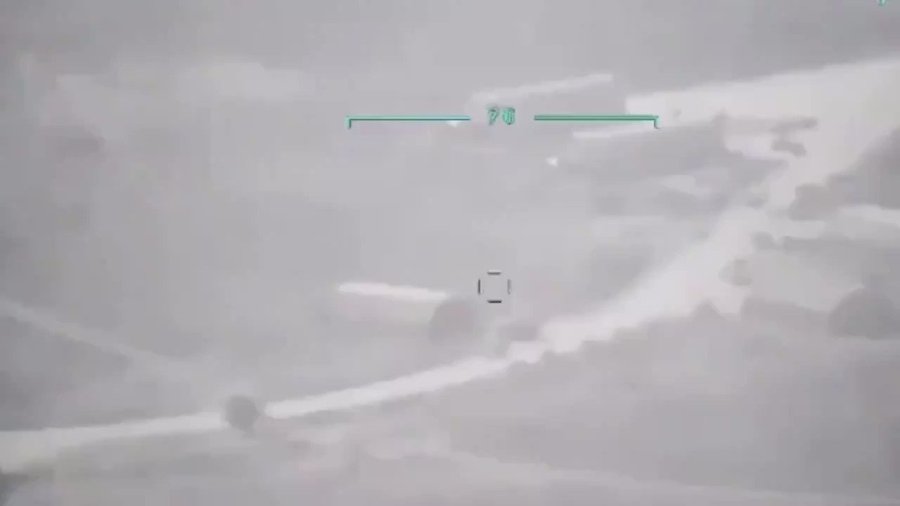
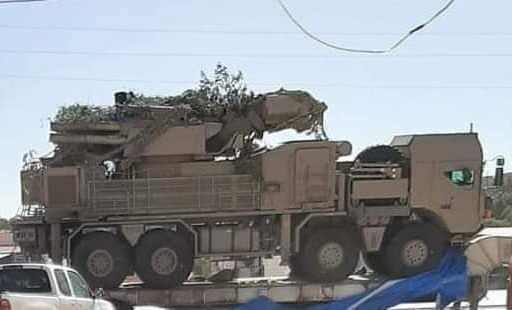
Nelle ultime ore il GNA ha reso noto un video che mostrerebbe il lancio di un missile da un drone turco contro uno shelter corazzato nel quale si suppone fosse nascosto un sistema di difesa aerea Pantsir S1 fornito dagli Emirati Arabi Uniti all’LNA.
Il comando delle forze di Haftar a Bengasi ha invece annunciato ieri era che un analogo sistema antiaereo avrebbe abbattuto (nella foto d’apertura) ieri un drone turco, probabilmente un TAI Anka, mentre sorvolava la base aerea di al-Watiya, 140 chilometri a sud di Tripoli e a 30 chilometri dal confine tunisino. Benchè parzialmente distrutto dagli scontri e soprattutto dai bombardamenti del GNA dell’ultimo mese, l’aeroporto ha un valore strategico per entrambi i contendenti.
La mattina del 18 maggio il GNA ha annunciato di aver occupato la base aerea di al-Watiya.  “Il generale Osama al-Juwaili, capo della Sala operazioni congiunte ha reso noto che le nostre forze eroiche hanno preso il controllo della base aerea di al-Watiya” si legge sull’account Facebook dell’ Operazione “Vulcano di rabbia”.
Pantsir_Libya-1
La notizia è stata confernata dallo stesso capo del governo di Tripoli, Fayez al-Sarraj.
Il possesso della base aerea avrebbe permesso all’LNA di riprendere in futuro l’offensiva nell’ovest della Tripolitania; la sua conquista invece consentirà al GNA di cancellare la presenza nemica in quella regione mentre secondo alcune indiscrezioni alla base sarebbe interessata l’Aeronautica Turca che vorrebbe rischierarvi alcuni caccia F-16C per affiancare i droni Bayraktar oggi impiegati da Mitiga, Misurata e da altre piccole piste d’aviazione nei dintorni di Tripoli.
La presenza degli F-16C turchi nei cieli libici è già stata segnalata da alcune fonti d’intelligence ma sarebbe sporadica per la necessità di far decollare i caccia dalla Turchia rifornendoli in volo sul Mediterraneo con le aerocisterne KC-135. Oltre a questi velivoli la Turchia impiega sulla Libia anche aerei cargo C-130 e aerei radar Boeing E-7T oltre ai velivoli teleguidati Anka e Bayraktar.
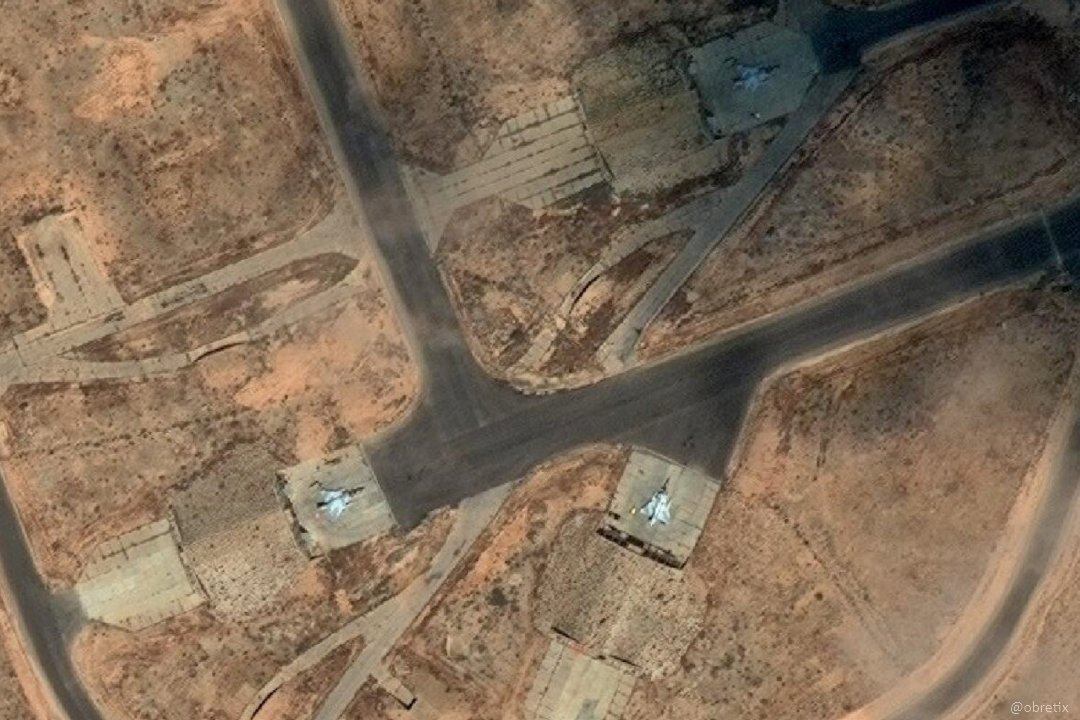
Un’iniziativa che rappresenterebbe la risposta di Ankara al recente rischieramento in appoggio all’LNA di almeno 6 Mirage 2000 emiratini nella base aerea di Sidi el-Barrani, nell’Egitto occidentale non lontano dal confine libico, svelati da alcune foto satellitari (qui sotto).
EXWgAr-U4AU0Ivf
L’obiettivo di Abu Dhabi, che già da tempo schiera nella base di al-Khadim, non lontano da Bengasi, elicotteri, droni Wing Loong 2 e aerei antiguerriglia AT-802U a supporto dell’LNA, è bilanciare la superiorità nei cieli acquisita negli ultimi mesi dal GNA grazie all’intervento della Turchia che sembra aver pagato il successo con la perdita di almeno 32 droni in turco dal novembre 2019.
Inoltre l’LNA ha reso noto nei giorni scorsi di aver ripristinato l’efficienza operativa di 4 cacciabombardieri già in servizio (ereditati dalle forze aeree di Gheddafi) senza però precisare se si tratti di Mig 21, Mig 23 o Mirage F-1
Non è la prima volta che F-16C egiziani e Mirage 2000 egiziani o emiratini vengono segnalati in azione nei cieli libici in appoggio alle truppe di Haftar ma le ultime segnalazioni potrebbero indicare un’escalation del conflitto aereo che un ruolo diretto e continuativo dei caccia dei paesi che supportano direttamente le due fazioni libiche: di fatto la manifesta internazionalizzazione del conflitto.

Rinforzi per tutti
Uno sviluppo che rappresenta una conseguenza diretta delle sconfitte di Haftar a ovest di Tripoli e dell’arresto della sua offensiva a sud della capitale e a est di Misurata, determinate direttamente dall’intervento di militari turchi (stimati tra 500 e mille unità) e dei mercenari siriani arruolati da Ankara il cui numero era valutato a marzo in circa 5mila (a cui sottrarre almeno 500 tra morti, feriti e prigionieri) ma che secondo sarebbe salito attualmente a quasi 8mila unità, a conferma della volontà turca di aiutare il GNA a respingere il nemico lontano da Tripoli e, lungo la costa a est di Misurata, di ricacciarlo a Sirte.
5e089aba42360428fc11a6ae-3-780x405-1
Il 6 maggio l’Osservatorio per i diritti umani in Siria (Ondus, con sede a Londra), ha reso noto che negli ultimi mesi il governo di Ankara ha inviato in Libia 7.850 miliziani, siriani e di nazionalità non precisate, mentre ha radunato nei centri di addestramento in Turchia circa altri 3mila combattenti. L’Ondus ha aggiunto che a quella data si registravano 261 mercenari siriani uccisi in battaglia in Libia.
Tali forze sarebbero concentrate al momento soprattutto a Tripoli e Garabulli per sostenere l’offensiva verso Tarhuna, 70 chilometri a sud di Tripoli dove le forze dell’LNA hanno il loro comando e resistono da settimane alla pressione nemica sostenuta dal cielo dai droni turchi che avrebbero distrutto al suolo nelle ultime settimane almeno due cargo dell’LNA, un Iliyushin Il-76 e un Antonov An-26 che per rifornire la città utilizzano la striscia d’asfalto della strada per Tripoli.
Al netto delle dichiarazioni dei contendenti la situazione su questo fronte è molto vivace ma non sembra indicare svolte decisive anche se la caduta di al-Watya nell’ovest potrebbe consentire al GNA di concentrare maggiori forze intorno a Tarhuna.
محور ترهونة
L’LNA resiste intorno a Tarhuna e non lesina contrattacchi verso Garabulli il cui possesso permetterebbe alle forze di Haftar di tagliare la strada costiera impedendo i collegamenti tra Tripoli e Misurata.
Al tempo stesso l’LNA ha accentuato i bombardamenti con razzi d’artiglieria su Tripoli, in particolare sull’aeroporto di Mitiga impiegato dai velivoli cargo e dai droni turchi, sul porto e sulle aree adiacenti e ambasciate di Italia e Turchia, i principali sostenitori del GNA. Bombardamenti che hanno indotto Ankara a minacciare Haftar di rappresaglie militari contro la Cirenaica.
I droni Wing Loong 2 dell’LNA (ma gestiti da contractors al solo degli Emirati Arabi Uniti) hanno bombardato anche il comando delle forze del GNA a Zuara, a ovest di Tripoli e le postazioni nemiche a Gharyan, ex caposaldo dell’LNA a sud della capitale, riconquistato dal GNA l’anno scorso.
ترهونة2_0
A causa della superiorità aerea del GNA, Haftar ha difficoltà a rifornire le truppe a sud di Tripoli e le incursioni dei droni turchi hanno colpito nelle ultime settimane diversi convogli che da Bani Walid puntavano a raggiungere Tarhuna dove il comando dell’LNA inquadra anche contractors russi e militari emiratini e giordani.
Anche sul fronte di Misurata l’LNA è stato costretto a ripiegare verso est, tra Abu Grein e Sirte.
Le difficoltà dell’LNA stanno inoltre incoraggiando alcune tribù a cessare il sostegno ad Haftar e a schierarsi col GNA come hanno fatto ad ovest le milizie berbere della regione del Nefusa e come sembra stia accadendo anche nell’area di Murzuq, a sud di Sebha, nel profondo meridione libico, dove i Tebu mobilitano le milizie e rifiutano di accettare il dominio di Haftar.

Haftar punta al controllo politico
Le sconfitte e le incertezze militari hanno determinato un approccio critico nei confronti del generale da parte dei suoi principali sponsor militari (Egitto, Russia ed Emirati Arabi Uniti) e maggiori aperture all’iniziativa di Aguilah Saleh, autorevole presidente del parlamento di Tobruk considerato vicino a russi e sauditi che vorrebbe un negoziato di pace con Tripoli.
Per scongiurare tale iniziativa, che potrebbe di fatto esautorarlo, il 27 aprile Haftar ha annunciato una sorta di golpe in Cirenaica dichiarando di accettare un fantomatico “mandato popolare” a governare tutta la Libia indicato da alcune manifestazioni di piazza di suoi fedelissimi.
Haftar ANSA
Il generale ha annunciato in televisione di avere un “mandato per svolgere un compito storico” per “occuparsi del Paese”, attribuendosi pieni poteri per governare la Libia, in realtà solo i territori sotto il controllo delle sue forze.
Haftar ha quindi denunciato l’accordo di Skhirat col quale l’ONU diede vita al governo di Fayez al-Sarraj a Tripoli pur riconoscendo la legittimità del parlamento di Tobruk, fino a ieri vicino ad Haftar.
Con l’aiuto dei militari Haftar sta costituendo il Consiglio di sovranità libico, di fatto un governo i cui ministri saranno per lo più generali che esautorerà l’esecutivo della Cirenaica guidato da Abdullah al-Thani e terrà sotto scacco il parlamento di Tobruk, col compito di mettere a punto nuove elezioni presidenziali e parlamentari che sarebbero ovviamente pilotate da Haftar ed effettuate solo nelle regioni sotto il suo controllo.
Il 16 maggio un gruppo di deputati del parlamento di Tobruk ha condannato l’arresto da parte degli uomini di Haftar del ministro del Tesoro del governo della Cirenaica, Kamel al Hasi, considerato vicino alle posizioni favorevoli al negoziato con Tripoli di Aguila Salehg. In una nota una decina di deputati definiscono l’arresto del ministro “illegale” e ne chiedono l’immediata scarcerazione.
Roma, 6 giu. (askanews) - "Grande avanzata" delle forze che fanno capo al governo di unità nazionale libico che pur con "pesanti perdite umane" sono riuscite ad conquistare una caserma militare che dista appena 20 chilometri a sud-est di Sirte, roccaforte del Califfato sulla costa settentrionale del Paese Nordafricano: Lo riferiscono media locali. Secondo quando scrive sul suo sito on-line la tv Libya Channel il comando delle operazioni "al Bunian al Marsus" (dall'arabo "Struttura Solida" come viene denominata l'operazione per la liberazione di Sirte) del governo di unità nazionale "dopo violenti combattimenti con gli elementi del gruppo terroristico, le nostre forze hanno preso sotto il controllo la caserma militare nota (all'epoca di Gheddafi) come 'La Brigata al Saadi' nella zona di Abu Hadi" che si trova a 20 chilometri a sud-est di Sirte. Secondo fonti militari "la presa di questa sede apre lo spazio per il controllo della strada che collega l'entroterra con il centro di Sirte". Di "grande avanzata" verso Sirte ma anche di "dolorose perdite" parla l'inviato degli Stati Uniti in Libia, Jonathan Winer citato dal sito news locale al Wasat. In un tweet postato sul suo account stamane, l'inviato americano ha scritto che "le operazioni militari contro l'Isis in Libia sono riuscite a tagliare le vie dei rifornimenti a est come a ovest e sud della città di Sirte". Secondo al Wasat il pronto soccorso dell'ospedale di Misurata ha ricevuto ieri sera il corpo di tre militari uccisi nei combattimenti vicino a Sirte oltre ad una ventina di feriti.
Il “golpe” militare del generale, almeno ufficialmente, ha riscosso critiche e scetticismo anche tra i paesi alleati di Haftar anche se, come spesso accade, nella crisi libica il gioco delle parti è prassi comune e molti Stati hanno agito in passato in aperta contraddizione con quanto dichiarato. Tutti a parole si dicono a favore di negoziati di pace ma ognuno sostiene con armi e denaro la propria fazione.
La forza di Haftar, che a 76 anni e in un momento di complessiva debolezza militare non intende rinunciare al ruolo di protagonista, è riposta nella consapevolezza dei paesi arabi che le sue milizie costituiscono l’unico strumento con cui ostacolare la massiccia penetrazione turca (e del Qatar) in Libia.
In questo contesto si inseriscono i rifornimenti e i rinforzi in arrivo per l’LNA anche dalla Siria, dove secondi molte fonti i russi stanno arruolando migliaia di miliziani siriani governativi da trasferire in Cirenaica con i primi contingenti già sbarcati a Bengasi da un aereo cargo russo nella prima decade di aprile.
Un’operazione finanziata probabilmente dagli Emirati Arabi Uniti, oggi partner di Bashar Assad, che viene interpretata come un rafforzamento della penetrazione russa in Libia, dove già operano contractors della società militare privata Wagner stimati tra 800 e 1.200 unità da un rapporto confidenziale della missione dell’ONU in Libia rivelato dall’agenzia di stampa Reuters il 7 maggio.

L’irritazione di USA e NATO
Il ruolo russo in Libia e l’invio di combattenti siriani a rinforzo dell’LNA, denunciato anche dall’inviato speciale di Washington per la crisi siriana, Jim Jeffreys, sta irritando Stati Uniti e influenzando, di conseguenza, i vertici della NATO che però erano rimasti quasi impassibili di fronte allo sbarco a Tripoli di migliaia di miliziani jihadisti siriani arruolati da Ankara.
3SGy4fwe
Iniziative che stanno favorendo da un lato il ricompattamento tra l’Alleanza Atlantica e la Turchia e dall’altro più stretti rapporti tra il GNA e gli USA.
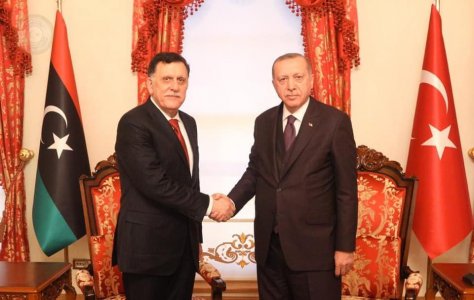
Il premier di Tripoli, Fayez al Sarraj (nella foto a lato con il presidente turco Erdogan), ha avuto il 15 maggio un colloquio telefonico con il segretario generale della NATO, Jens Stoltenberg, che ha confermato che il GNA è il governo legittimo della Libia ed ha aggiunto che i raid che colpiscono i civili “non sono tollerabili”, ribadendo che “non c’è soluzione militare per la crisi libica e che è necessario attenersi alle conclusioni della conferenza di Berlino”.
Lo stesso giorno Stoltenberg ha avuto un colloquio telefonico anche con il presidente turco Recep Tayyip Erdogan, ribadendo (lo riporta una nota di Ankara) la disponibilità della Nato ad aiutare il governo di Tripoli ad aumentare le proprie capacità securitarie e di difesa nel pieno sostegno a una soluzione politica alla crisi.
Nei giorni precedenti Henry Wooster, vice segretario aggiunto dell’Ufficio degli affari del Medio Oriente del Dipartimento di Stato aveva dichiarato che “gli Stati Uniti non sostengono l’azione dell’LNA contro Tripoli. L’attacco alla capitale devia le risorse da quella che è una priorità per noi, ovvero l’antiterrorismo”.

L’Operazione Irini  e la sfida energetica
Resta invece critica la valutazione del GNA nei confronti dell’Unione Europea dell’operazione navale Irini che dovrebbe contrastare le forniture di armi ai contendenti libici ma che di fatto ha le potenzialità per mettere in difficoltà solo i convogli navali turchi diretti a Tripoli e Misurata.
163550151-c759b104-00ee-4d40-85f0-dde90c747e66
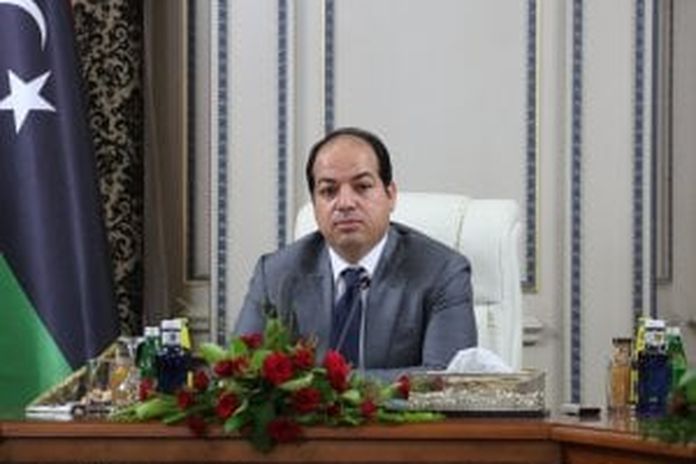
Il 4 maggio il vice del GNA, Ahmed Maitig (nella foto a lato ), ha affermato che l’Operazione Irini “non è sufficiente e trascura il monitoraggio delle frontiere aeree, marittime e terrestri orientali della Libia. L’Unione europea non ha consultato il nostro governo prima di prendere la decisione di avviare l’operazione che si affaccia sui confini orientali”, ha aggiunto Maitig durante un incontro con l’ambasciatore d’Italia a Tripoli, Giuseppe Buccino.
Al-Sarraj, in un’intervista al Corriere della Sera ha rincarato la dose dichiarando che la nuova missione europea ha “come obiettivo primario quello di fare rispettare l’embargo Onu contro l’invio di aiuti militari stranieri in Libia.
La sua area d’operazioni è il mare Mediterraneo ma ai nostri nemici armi e munizioni arrivano principalmente via terra e aria. I nostri porti saranno controllati, le nostre truppe penalizzate, mentre gli scali di Haftar saranno liberi di ricevere ogni aiuto e le sue milizie di utilizzare qualsiasi tipo di rinforzo militare”.
Superficiale e poco concreta la risposta giunta dal portavoce della Commissione Ue, Peter Stano. “Posso solo dire che Irini è un concreto esempio di come l’Ue voglia contribuire alla pace in Libia. Il suo mandato mira a contribuire al rispetto dell’embargo dell’Onu così da prevenire il flusso di armi verso la Libia e di partecipare al raggiungimento di una soluzione politica”.
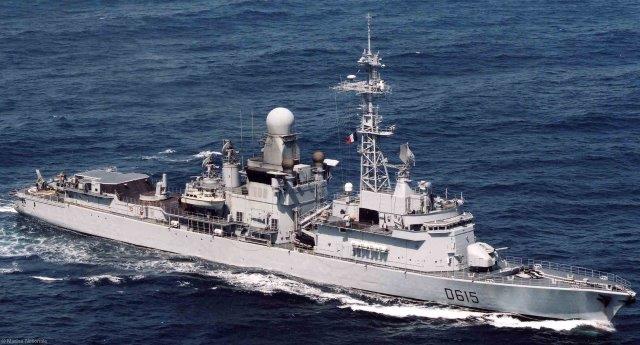
D615-Jean-Bart-17
Da un lato Irini non sembra avere molto supporto dagli stessi Stati Ue. è in mare con una sola nave, la fregata francese Jean Bart (nella foto a lato), che verrà però riturata a fine mese quando entreranno in azione una nave per operazioni anfibie (LPD) italiana e una fregata greca: navi che solo in estate potrebbero venire affiancate da una nave tedesca, probabilmente un rifornitore di squadra.
La ragione dell’avvio lento e poco convincente dell’operazione navale Ue a comando italiano sembra legato a due aspetti: i greci interpretano la missione come una iniziativa anti-turca mentre molti partner del nord Europa non hanno intenzione di farsi coinvolgere in un’iniziativa che potrebbe portarli ai ferri corti con Ankara.
La Turchia, che la considera illegittima, rileva come non casuale il fatto che l’area operativa dell’Operazione Irini sia situata di fronte alle coste della Cirenaica, in quello specchio di mare che in base all’accordo bilaterale del 29 novembre 2019 appartiene alla Zona economica esclusiva (ZEE) Turchia e Tripoli intendono sfruttare congiuntamente.
Il 15 maggio la Turkish Petroleum Company (Tpao) ha chiesto al GNA il permesso di effettuare prospezioni petrolifere nel Mediterraneo orientale. “Le attività di prospezione inizieranno non appena il processo sarà completato”, ha dichiarato il ministro turco dell’Energia, Fatih Donmez, durante una conferenza stampa ad Ankara.
d975fa7d-1d87-4d0e-9d5c-8c663b90be0d
La dichiarazione è giunta dopo che i ministri degli Esteri di Grecia, Cipro, Egitto, Francia ed Emirati Arabi Uniti (in pratica tutti avversari di Ankara e sponsor del generale Haftar) hanno denunciato le “attività illegali turche in corso” nella ZEE di Cipro e nelle sue acque territoriali, nonché le “ingerenze” turche in Libia.
I cinque hanno ricordato “l’impegno ad astenersi da qualsiasi intervento militare straniero in Libia, come concordato nelle conclusioni della conferenza di Berlino e condannato “fermamente l’interferenza militare della Turchia in Libia” esortandola a “rispettare pienamente l’embargo sulle armi”.
Grecia, Cipro ed Egitto sono inoltre accomunati dalla condanna del memorandum d’intesa fra Ankara e Tripoli sulla delimitazione delle giurisdizioni marittime nel mar Mediterraneo, che a loro giudizio lede i loro diritti sovrani.

Gianandrea Gaiani

Giornalista bolognese, laureato in Storia Contemporanea, dal 1988 si occupa di analisi storico-strategiche, studio dei conflitti e reportage dai teatri di guerra. Dal febbraio 2000 dirige Analisi Difesa. Ha collaborato o collabora con quotidiani e settimanali, università e istituti di formazione militari ed è opinionista per reti TV e radiofoniche. Ha scritto diversi libri tra cui "Iraq Afghanistan, guerre di pace italiane" e “Immigrazione, la grande farsa umanitaria”. Dall’agosto 2018 al settembre 2019 ha ricoperto l’incarico di Consigliere per le politiche di sicurezza del ministro dell’Interno.